Brent Nears $100/bbl Following Iranian Threats to Gulf Energy Infrastructure
 admin
admin 
Oil prices continued their upward trajectory on Tuesday, with Brent crude climbing past $98 a barrel. The surge comes as market participants assess the heightened risk of supply disruptions in the Middle East following Iran’s warning that it could target oil and gas infrastructure throughout the Gulf region in response to any attacks on its own assets.
By 07:51 ET (11:51 GMT), November Brent crude futures rose 1.7% to reach $98.64 per barrel, while West Texas Intermediate (WTI) crude futures jumped 2.7% to trade at $93.92 per barrel. This follows Monday’s session, where Brent closed nearly 1% higher after briefly hitting the $98 threshold.
The recent price spike is driven by escalating tensions after Iran threatened to establish a maritime exclusion zone across the Persian Gulf in retaliation to what it termed U.S. “economic warfare.” This warning follows a series of weekend strikes between the U.S. and Iran, which included targeting commercial shipping.
Iranian authorities explicitly warned that American energy interests and regional infrastructure are highly vulnerable. Mohammad Baqer Qalibaf, the Speaker of the Iranian Parliament, stated that the sprawling oil and gas facilities in the area are exposed, warning that any strikes on Iranian assets would be met with direct retaliation.
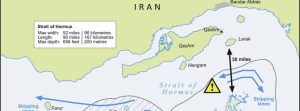
The primary concern for global energy markets remains the Strait of Hormuz. Iran’s announcement of a potential new restricted zone and an alternative shipping route has fueled fears of slower tanker traffic through this critical maritime chokepoint. Mohsen Rezaei, secretary of Iran’s Supreme National Security Council, indicated on social media that the U.S. has been warned, and that economic pressure would be countered with a wide-ranging maritime exclusion zone.
In response to the persistent tensions, Goldman Sachs adjusted its long-term price forecasts upward by $5. The bank now projects Brent and WTI to average $85 and $80, respectively, for December 2026, and $80 and $75 for 2027, anticipating that shipping disruptions in the Middle East will continue for several years.
However, analysts noted that the price forecast increases remain relatively moderate. This is partly because commercial land inventories in OECD countries have not decreased significantly since the conflict began, indicating a smaller-than-expected supply deficit. Additionally, experts anticipate that global energy markets will continue to adapt, with production expected to recover in the latter half of 2027 through alternative transit routes and increased dark-fleet flows.
Though Iran indicated it is nearing an agreement with Oman regarding transit through the Strait of Hormuz—which could potentially mitigate some shipping bottlenecks—investors remain doubtful that diplomatic efforts will resolve the broader standoff between Washington and Tehran. The ongoing friction has heavily impacted prices, with Brent gaining 8% and WTI rising nearly 10% over the previous week.